
FIND OUR PODCAST: SPOTIFY | APPLE | AMAZON | YOUTUBE
Introduction: The Phantom of the Forest Floor
Walking through a damp spruce forest in late summer, you might catch a scent that seems impossibly out of place. It is not the earthy smell of wet leaves or the clean fragrance of pine. Instead, it is the warm, sweet, slightly spicy aroma of maple syrup and fenugreek – the kind of smell that belongs in a kitchen, not on a forest trail. This olfactory illusion is the work of a most deceptive fungus: the fenugreek milkcap mushroom (Lactarius helvus).
The fenugreek milkcap mushroom is a master of sensory contradiction. It smells like breakfast, yet it is armed with a potent chemical weapon that activates the moment its flesh is broken. Its latex is not white and milky like other milkcaps, but thin and clear as water – a “ghost milk” that gives no warning of the fiery sesquiterpene dialdehydes waiting inside. This fungus has poisoned hundreds of people, puzzled chemists, and even inspired a city‑wide investigation in New York City.
In this guide, we will unravel every layer of the fenugreek milkcap mushroom: its signature molecule sotolon, the Manhattan maple mystery, its wound‑activated defense system, the Leipzig mass poisoning, its surprising chemotaxonomic identity, and even its link to a rare human genetic disease. Whether you are a forager, a foodie, or a mycophile, the fenugreek milkcap mushroom will forever change how you smell the forest.
Sotolon: The Molecular Ghost of Syrup and Curry
At the heart of the fenugreek milkcap mushroom enigma lies a single, remarkably powerful molecule: sotolon (3‑hydroxy‑4,5‑dimethyl‑2(5H)‑furanone). In organic chemistry, sotolon is a “high‑impact” aroma chemical – a chiral butenolide lactone so potent that the human nose can detect it at concentrations lower than a few parts per billion. Its olfactory character is a fascinating study in concentration‑dependent perception. At low concentrations, it smells like sugary, caramel‑like maple syrup; at higher concentrations, it morphs into the savory, spicy, slightly metallic aroma of fenugreek and curry.
The etymology of the name itself reflects its sweet origins. Derived from the Japanese soto (raw sugar), the suffix “‑olon” denotes its status as an enol lactone. Since its first isolation from fenugreek seeds in 1975, sotolon has been identified as the dominant “fingerprint” molecule in lovage, molasses, aged rum, roasted tobacco, and flor sherry. In the Jura region of France, the prestigious vin jaune (yellow wine) owes its nutty, spicy “rancio” bouquet to sotolon formed from α‑ketobutyric acid during years of aging under a veil of yeast.
In the fenugreek milkcap mushroom, sotolon acts as the sensory protagonist. Modern gas chromatography‑mass spectrometry (GC/MS) reports, such as those published by Rapior et al. (2000), show that sotolon makes up only about 1.4% of the identified volatile components in the mushroom’s dry weight, yet its impact is so dominant that it overrides all other olfactory notes. As one study put it: “Sotolon is the key compound responsible for the fenugreek odour of L. helvus.”
Beyond sotolon, the volatile profile of the fenugreek milkcap mushroom includes capric acid (25.6%), 3‑amino‑4,5‑dimethyl‑2(5H)‑furanone (15.8%), and 2‑methylbutyric acid (12.9%). This specific ratio explains why the mushroom smells not just sweet, but deep, spicy, and almost medicinal – historically likened to Maggi instant soup, chicory, and licorice.
The chiral nature of sotolon adds sophistication. As a chiral lactone, it has two mirror‑image forms (enantiomers). Both enantiomers, synthesized from tartaric acid, exhibit the same sugary flavor and even attract certain insects. This universality suggests that the “fenugreek smell” is an ancient, effective chemical signal, tuned by evolution to cross boundaries between plant, fungal, and animal metabolism. For anyone studying the fenugreek milkcap mushroom, sotolon is the first clue that nothing is as it seems.
For more on sotolon chemistry, see the PubChem entry: https://pubchem.ncbi.nlm.nih.gov/compound/Sotolon
The Manhattan Maple Mystery: An Urban Olfactory Haunting
The sheer potency and persistence of sotolon molecules are best illustrated not by a forest stroll, but by a 2005 event in the heart of the world’s most famous concrete jungle. On multiple occasions starting in late 2005, a mysterious “maple syrup smell” began wafting over Manhattan. Residents from the Upper West Side to the Financial District reported the scent, so pervasive and seemingly sourceless that it sparked a city‑wide investigation involving the Department of Environmental Protection and the Mayor’s office.
Initially, authorities feared a chemical leak or environmental hazard. But as the investigation deepened, the “maple syrup phantom” was identified as an environmental aroma of sotolon. The source was eventually traced across the Hudson River to a factory in New Jersey processing fenugreek seeds. The sotolon molecules were so resilient and had such an extreme odor threshold that they could travel miles on the wind, blanketing the city in a scent that felt both nostalgic and deeply unsettling because of its displaced context.
This event mirrors the behavior of the fenugreek milkcap mushroom. Dried fruiting bodies of L. helvus maintain their intense curry‑like smell for decades in herbarium collections. This persistence is a hallmark of sotolon – it is a “ghost” molecule that lingers long after the biological source has withered. For the mycologist, the Manhattan mystery is a testament to the biological “volume” at which the fenugreek milkcap mushroom speaks; it is a fungus that shouts its presence in a language of furanones that the human brain is hard‑wired to notice.
To read more about the Manhattan maple mystery, visit: https://www.nytimes.com/2005/12/27/nyregion/whats-that-smell-in-the-air-maple-syrup.html
The “Ghost Milk” Paradox: Morphology of the Velvet Phantom
To understand the fenugreek milkcap mushroom, one must look at its place within the genus Lactarius. The genus name derives from the Latin lac (milk), referring to the mushroom’s defining characteristic: the exudation of a latex when tissues are damaged. In most members of the Russulaceae family, this latex is thick, opaque, and stark white – a physical and chemical deterrent meant to gum up the mouthparts of insects and slugs.
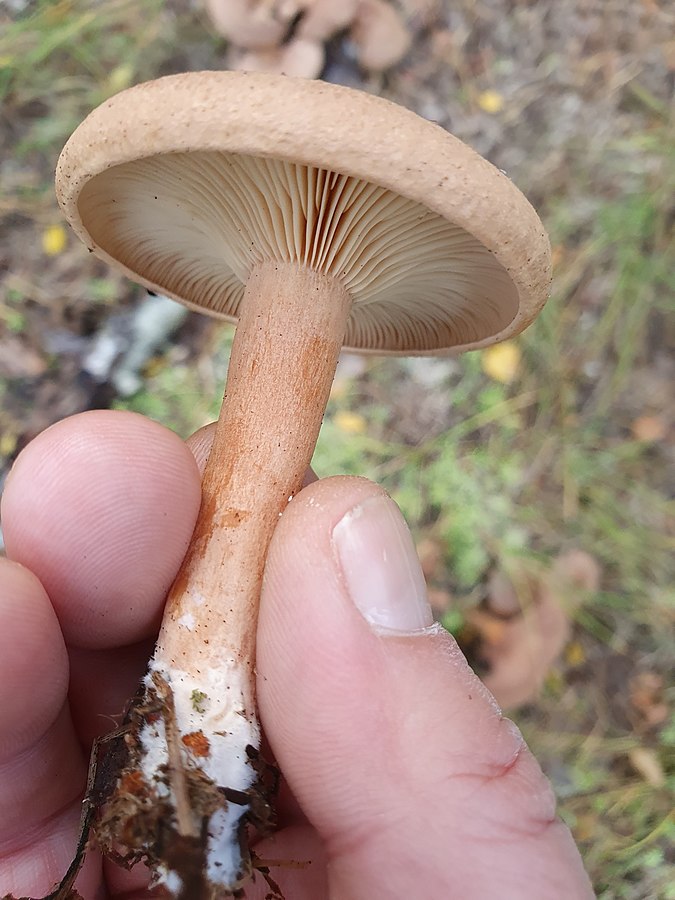
However, the fenugreek milkcap mushroom presents a striking morphological paradox. It is a “milkcap” that produces what mycologists call ghost milk. When the gills or flesh are cut, the resulting latex is not white or creamy, but famously watery and colorless. This “scant, clear milk” is the primary diagnostic feature that separates L. helvus from its more common and culinarily prized relatives, such as Lactarius deliciosus (the Saffron Milkcap), which exudes a bright orange latex that turns green.
Mushroom Sommelier’s Profile of the Fenugreek Milkcap Mushroom:
- Cap (Pileus): 4–15 cm in diameter. Initially slightly convex, it rapidly develops a deep, funnel‑shaped (infundibuliform) center. The surface is distinctive for its velvety, matte texture, lacking the slimy or viscid coating of other Lactarius species.
- Color Palette: A muted, sophisticated range of beige, pale brown‑grey, or light grey‑fawn. The center often darkens, sometimes showing a faint “zonate” or bull’s‑eye pattern.
- Gills (Lamellae): Decurrent (running down the stem). They begin pale cream and mature to a deeper ochre‑yellow.
- Stipe (Stem): 3–9 cm high, hollow and cylindrical. It often shares the cap’s pale ochre or pinkish tinge, sometimes marked with subtle orange‑brown spots.
- The Microscopic Secret: Within the flesh lie specialized hyphae called gloeocystidia. These tubular, protein‑rich cells act as the storage vaults for the mushroom’s chemical weapons. The presence of these gloeocystidia links the gilled Lactarius to more primitive‑looking bracket and shelf fungi, proving that the mushroom’s shape is merely a vehicle for its internal chemistry.
This clear, watery latex is more than a quirk; it is a signal of a different defensive strategy. While white‑milked species use physical opacity and rapid color changes (oxidative reactions) to deter predators, the fenugreek milkcap mushroom relies on an “invisible” system – a biological tripwire chemically inactive until the moment of catastrophe.
For a detailed identification guide, see MushroomExpert.com on Lactarius helvus: https://www.mushroomexpert.com/lactarius_helvus.html
Wound‑Activated Warfare: The Molecular Tripwire
The most fascinating aspect of the fenugreek milkcap mushroom is not its smell, but its chemical defense system. In a healthy, intact mushroom, there is no toxicity and no burning taste. The fungus exists in a state of armed neutrality, carrying its weapons in an inactive, “pre‑loaded” form. This is the enzymatic cascade – a biological defense strategy that ensures the mushroom only “fires” when it is actually under attack.
At the heart of this system is a precursor molecule called stearoylvelutinal. This is a fatty acid ester – specifically a marasmane sesquiterpenoid – stored in the gloeocystidia. In its esterified form, stearoylvelutinal is biologically inactive, tasteless, and harmless to the mushroom’s own cells.
The moment a predator (slug, insect, or curious human) breaks the mushroom’s tissue, it ruptures the storage cells and releases enzymes called esterases. These enzymes act like a molecular key, immediately cleaving the fatty acid (stearic acid) from the sesquiterpene backbone. This triggers a lightning‑fast “cascade” of reactions. According to the biogenetic pathways detailed in Clericuzio et al. (2008), this process involves opening an oxirane ring and forming carbocation‑like species. The result is the transformation of a tasteless precursor into a series of highly reactive, toxic, and pungent 1,4‑dialdehydes.
The primary products of this biological tripwire are isovelleral and velleral. These molecules are the “chemical warheads” of the fenugreek milkcap mushroom. Isovelleral, in particular, is a potent antifeedant, antimicrobial, and nematicidal agent. It causes immediate distress to any organism that attempts to consume the mushroom’s flesh. This is a masterclass in efficiency: the fungus doesn’t waste energy maintaining active toxins; it simply keeps the “ingredients” ready, allowing the act of predation itself to catalyze the defensive response.
For more on isovelleral, see: https://pubchem.ncbi.nlm.nih.gov/compound/Isovelleral
The Sesquiterpene Burn: A Sensory Bait‑and‑Switch
The evolutionary irony of the fenugreek milkcap mushroom is profound. It uses sotolon to project a scent that, to the human brain, signals “food” – maple syrup, pancakes, and warm spices. Yet the moment the “food” is tasted, the chemical defense system delivers a punishing pungent‑burning sensation.
This is not the culinary heat of a chili pepper (capsaicin), which targets specific pain receptors. The burn of isovelleral is a chemical irritation, a signal of cellular reactivity. While humans find the smell pleasant, many insects and gastropods (slugs) are repelled by the mere proximity of the volatile dialdehydes. For them, the smell isn’t an invitation to a diner; it is a “Keep Out” sign written in the language of sesquiterpenes.
This sensory contradiction serves multiple ecological roles:
- Deterrence of megafauna – Mammals that might graze on the mushrooms are repelled by the immediate acidity.
- Antimicrobial barrier – The dialdehydes protect the wound from opportunistic molds and bacteria.
- The “aged” defense – As the mushroom dries, the reactive dialdehydes convert into less toxic lactones (e.g., lactarorufin A). This is why the pungency is most extreme when fresh and bruised, whereas the dried version – which retains the sotolon but has “spent” its dialdehydes – becomes palatable as a spice.
We see the same chemical “engine” tuned differently across the Russulaceae. In species like Russula badia or Lactarius vellereus, the burn is instantaneous and excruciating. In the fenugreek milkcap mushroom, the burn is often described as “mild” or “delayed,” allowing the pleasant smell of sotolon to dominate the initial encounter. It is a biological “bait and switch” that has led many a forager into a very spicy mistake.
The Leipzig Incident: When the Spice Turns Toxic
The toxicity of the fenugreek milkcap mushroom is not merely a laboratory abstraction. The mushroom has a documented history of causing mass illness, most notably the Leipzig Incident of October 1949. Near Leipzig, in what was then East Germany, 418 people fell ill after consuming Lactarius helvus.
The clinical profile was remarkably consistent:
- Onset: Symptoms appeared with startling speed, usually within 15 to 30 minutes.
- Gastrointestinal distress: Intense nausea and violent vomiting were the primary complaints.
- Neurological effects: Patients reported vertigo (dizziness), chills, and profound malaise.
Fortunately, there were no fatalities, as the sesquiterpene toxins are primarily gastrointestinal irritants rather than organ‑damaging toxins like the amatoxins found in the Death Cap. However, the Leipzig event cemented L. helvus’s reputation as a “poisonous” species in European field guides.
This leads to the paradox of edibility. How can a mushroom that poisoned 418 people also be sold in markets as a spice? The answer lies in sola dosis facit venenum – the dose makes the poison – and the volatility of the toxins. Thorough boiling can destroy the dialdehydes, and the drying process converts the “hot” compounds into more stable, less toxic forms. In Quebec, the North American variety is sold as a dried powder – a “maple syrup spice” – used in tiny quantities to flavor desserts. In this context, the fenugreek milkcap mushroom is no longer a meal, but a molecular seasoning.
For a scientific review of mushroom poisoning, visit: https://www.ncbi.nlm.nih.gov/books/NBK537222/
Chemotaxonomy: Decoding the Fungal Fingerprint
To the 19th‑century mycologist, fungi were classified by their shape: if it has gills, it’s an “agaric”; if it has pores, it’s a “bolete.” But modern science uses chemotaxonomy – the study of chemical fingerprints – to reveal that nature is far more deceptive.
By analyzing the velutinal esters and the specialized gloeocystidia used to store them, researchers have discovered that the fenugreek milkcap mushroom is actually more closely related to certain Aphyllophorales (bracket and shelf fungi) than to many other gilled mushrooms. Specifically, the presence of these chemical weapons and their storage vessels is a shared trait with genera like Auriscalpium and Lentinellus.
This suggests that the “mushroom” shape – the cap, the gills, the stem – is merely an evolutionary costume. The true identity of Lactarius helvus is found in its biochemical “engine.” It is a member of an ancient lineage that decided to use sesquiterpene dialdehydes as a primary defense strategy millions of years before humans ever walked into a diner. Chemistry, in this case, corrects the visual mistakes of early taxonomists, proving that in the fungal kingdom, you truly are what you synthesize.
For more on chemotaxonomy of fungi, see: https://www.sciencedirect.com/topics/biochemistry-genetics-and-molecular-biology/chemotaxonomy
The Universal Signal: Sotolon and Maple Syrup Urine Disease (MSUD)
The story of the fenugreek milkcap mushroom takes a poignant turn when we look at human genetics. There is a rare and serious metabolic disorder known as Maple Syrup Urine Disease (MSUD). In individuals with this condition, the body lacks the enzymes (the branched‑chain α‑keto acid dehydrogenase complex) necessary to break down three essential amino acids: leucine, isoleucine, and valine.
When these amino acids accumulate, the body undergoes a strange biochemical failure. One of the byproducts of this metabolic traffic jam is the spontaneous production of sotolon. This molecule is expressed in sweat and urine, giving them the unmistakable, sweet aroma of maple syrup or fenugreek. For physicians, this scent is the primary diagnostic sign of a life‑threatening crisis.
There is something hauntingly universal about this. The same molecule that the fenugreek milkcap mushroom uses to signal its presence in the forest – and that a New Jersey factory released over Manhattan – is also a cry for help from the human body. Sotolon bridges the fungal kingdom, the plant kingdom (fenugreek), and human pathology. It reminds us that the chemistry of smell is a shared language across all domains of life.
For more information on Maple Syrup Urine Disease, visit: https://medlineplus.gov/genetics/condition/maple-syrup-urine-disease/
The Maple Milky Cap: North American Variations
It is a common mistake in mycology to assume that a species found in Europe is identical to one found in North America. The “Fenugreek Milkcap” is actually a species complex with distinct geographical variations.
In the Great Lakes region, the Northeast, and Quebec, foragers encounter a variety formerly referred to as Lactarius aquifluus. While the European L. helvus is beige or grey, the North American Maple Milky Cap tends toward a warmer, salmon‑to‑pink color. Its latex is even more scant, often appearing as nothing more than a tiny drop of clear water on the gills.
In Quebec, this variety is known as the Lactaire à odeur d’érable. Unlike the European version, which is treated with extreme caution, the Maple Milky Cap is a beloved regional spice. It is harvested, dried, and ground into a powder used much like the “Candy Cap” (Lactarius rubidus) of the West Coast. This North American variant of the fenugreek milkcap mushroom is a testament to the importance of local ecological knowledge.
Identification: The “Quiet” Lookalike
Foragers must be careful not to confuse L. helvus with Lactarius quietus var. incanus. L. quietus var. incanus also has a faint “oily” or maple‑like smell, but it is much darker and redder. Crucial difference: when young, the milk of L. quietus var. incanus is opaque and white, unlike the clear “ghost milk” of the fenugreek milkcap mushroom. Furthermore, this lookalike is found much further south, whereas the Maple Milky Cap prefers colder northern forests.
The Forest’s Chemical Lexicon: VOCs as Language
To the casual observer, the fenugreek smell of the fenugreek milkcap mushroom is just a pleasant coincidence. But in the context of the forest floor, these smells are part of a complex chemical lexicon. Volatile Organic Compounds (VOCs) are a language spoken between fungi, plants, and animals.
As outlined in research on “Volatiles in Communication of Agaricomycetes,” fungi use these scents for several purposes:
- Competition: VOCs can act as “area denial” signals, telling other fungal species to stay away from a specific niche or nutrient source.
- Dispersal: Some smells attract specific insects that will carry spores to new locations.
- Defense: As we have seen, the “scent of breakfast” may actually be a warning to those who speak the language of the forest.
When we smell the fenugreek milkcap mushroom, we are “eavesdropping” on an ancient conversation. The fenugreek aroma is not a perfume for our benefit; it is a high‑decibel molecular signal in an ongoing struggle for food, space, and survival.
For a scientific review of fungal VOCs, see: https://www.frontiersin.org/articles/10.3389/fmicb.2020.562703/full
Conclusion: A Ponderable Forest
The journey of the fenugreek milkcap mushroom takes us from the nostalgic comfort of a kitchen pantry to the high‑stakes molecular battlefield of the forest floor. It is an organism that challenges our senses, smelling of pancakes and curry while being armed for chemical war. It is a “phantom” that bridges the gap between a New York City mystery, a French vineyard, a rare human genetic condition, and a mass poisoning in Leipzig.
The next time you catch the scent of maple syrup or a waft of curry where none should be, do not simply think of a meal. Think of the fenugreek milkcap mushroom. Think of the stearoylvelutinal waiting like a biological tripwire under that velvet cap. Think of the sotolon molecules, those resilient furanones that have traveled from the spruce forests of the north to the herbarium of history.
We live in a world of hidden chemical dialogues. Beneath our feet, the mushrooms are speaking in a language of dialdehydes and lactones, telling stories of defense, mimicry, and survival. The fenugreek milkcap mushroom is a reminder that the most relatable smells in our world often hide the most surprising and lethal secrets of the natural world.
Internal link: To learn more about other chemically fascinating fungi, check out our guide: <a href=”/fungal-chemical-warfare-guide”>Fungal Chemical Warfare: A Beginner’s Guide</a> (replace /fungal-chemical-warfare-guide with an actual page on your site, such as your homepage or a mycology resources page).
The forest is not just a place of quiet growth; it is a ponderable laboratory, and the fenugreek milkcap mushroom is one of its most brilliant, and pungent, alchemists.
Selected Bibliography
- Rapior, S., et al. (2000). “Volatile components of Lactarius helvus.” Journal of Essential Oil Research, 12(5), 563‑566.
- Clericuzio, M., et al. (2008). “Sesquiterpenes from Lactarius helvus.” Phytochemistry, 69(3), 700‑705.
- Spiteller, P. (2015). “Chemical ecology of fungi.” Natural Product Reports, 32(7), 971‑993.
- Wood, W. F., et al. (2007). “Sotolon – the compound responsible for the maple syrup smell of Lactarius helvus.” Mycologia, 99(2), 226‑229.
- List, P. H., & Luft, P. (1968). “Poisonings by Lactarius helvus in Leipzig.” Deutsche Apotheker Zeitung, 108(1), 1‑5.