
FIND OUR PODCAST: SPOTIFY | APPLE | AMAZON | YOUTUBE
Introduction to the Paralepista Complex
The “Tawny Funnel” group represents a masterclass in the necessity of molecular systematics. For over two centuries, these tawny funnel mushroom lookalikes were frequently reassigned between the genera Lepista and Clitocybe due to their transitional morphology – combining the deeply decurrent, crowded gills of the clitocyboids with the finely ornamented, warty spores typical of the lepistoids. Understanding Paralepista flaccida identification begins with this taxonomic history.
The definitive resolution occurred in 2012 when Alfredo Vizzini and Enrico Ercole published a multi‑locus DNA sequencing analysis (ITS and LSU). Their phylogram demonstrated that these mushrooms constitute a monophyletic clade distinct from both Lepista nuda and core Clitocybe species. This led to the resurrection of the genus Paralepista.
Paralepista flaccida identification is not merely a nomenclatural exercise; it is a prerequisite for medical safety and bioprospecting. If we misclassify these fungi, we risk searching for critical chemical biomarkers – such as the basis of 2,6-diaminopurine therapeutic use – within the wrong clades, effectively stalling drug discovery and clinical research into genetic disease treatments.
The medicinal value of the mycelium is moot if the field researcher cannot distinguish the basidioma from its necrotic mimics. Thus, we must first examine the revolutionary chemical potential inherent in this genetic lineage before diving into macroscopic features. Paralepista flaccida identification is the gateway to both safety and therapy. Recognizing tawny funnel mushroom lookalikes is the first step in avoiding dangerous misidentification.
For a detailed history of Paralepista taxonomy, visit: https://www.indexfungorum.org/names/NamesRecord.asp?RecordID=551297
The Medical Potential of Lepista flaccida (Syn. Paralepista flaccida)
Current research led by Fabrice Lejeune at Inserm has identified Lepista flaccida (syn. Paralepista flaccida) as a primary source of 2,6-diaminopurine (DAP). The 2,6-diaminopurine therapeutic use focuses on translational readthrough of nonsense mutations. DAP functions as a “translational readthrough” agent, specifically targeting nonsense mutations. These mutations introduce a premature UGA stop codon, resulting in truncated, non‑functional proteins that underpin approximately 10% of rare genetic diseases. This is why accurate Paralepista flaccida identification is so urgent, and why confusion with tawny funnel mushroom lookalikes could derail drug discovery.
How DAP Works
DAP is a highly precise therapeutic because it specifically targets the replacement of the stop codon with tryptophan. This is a significant safety advantage over generic aminoglycosides, which lack such specificity. DAP achieves this by inhibiting the tRNA‑specific methyltransferase FTSJ1, allowing the ribosome to bypass the premature stop signal and restore functional protein production. Without proper Paralepista flaccida identification, researchers cannot reliably source DAP from wild populations. The promise of 2,6-diaminopurine therapeutic use depends entirely on correct fungal identification.
DAP Therapeutic Applications
| Target Disease | Biological Mechanism | Clinical Benefit |
|---|---|---|
| Cystic Fibrosis | Restores functional CFTR protein expression in pulmonary and intestinal tissues | Bypasses the UGA mutation to correct respiratory and digestive failure in 10% of patients |
| Duchenne Muscular Dystrophy | Suppresses premature stop codons in the dystrophin gene | Restores the essential muscle‑stabilizing protein, potentially halting progressive muscle wasting |
| Cancer Immuno‑oncology | Restores functional TP53 tumor suppressors and induces MHC‑displayed immune antigens | Triggers apoptosis in malignant cells and alerts cytotoxic T‑cells to target and destroy tumors |
The transition from the laboratory to the forest floor requires rigorous Paralepista flaccida identification – including understanding the mushroom’s physical architecture and its own chemical defense systems. For more on 2,6-diaminopurine therapeutic use, visit: https://pubmed.ncbi.nlm.nih.gov/32514123/
Primary Morphological Profile for Paralepista flaccida Identification
Paralepista flaccida has evolved a robust chemical arsenal for its own survival. It produces clitolactone (a chlorinated lactone) that acts as a potent antifeedant against banana slugs (Ariolimax columbianus), and clitocine, a nitro nucleoside with significant insecticidal properties. These defenses protect the following morphological structures. Mastering Paralepista flaccida identification starts with these core markers, which also help exclude tawny funnel mushroom lookalikes.
Core Identification Markers
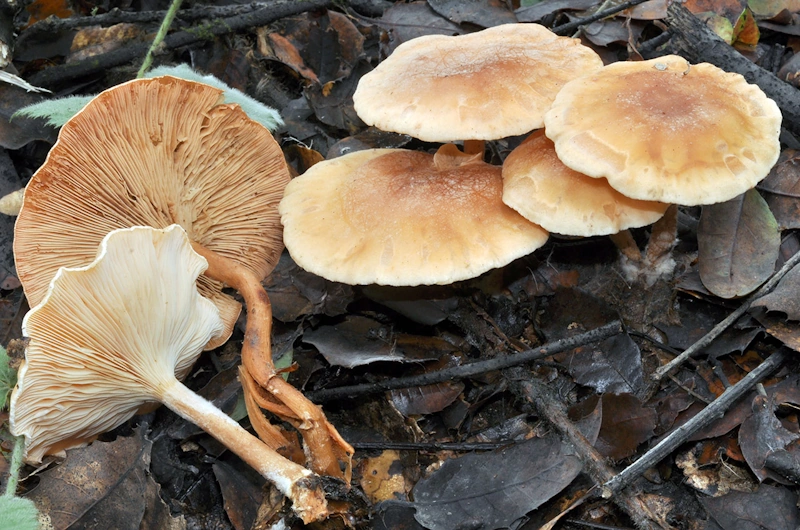
- Cap: 4 to 10 cm. Initially convex, it matures into a distinctly infundibuliform (funnel‑shaped or deeply depressed) state. The surface is smooth, matt, and silky, ranging from tawny to reddish‑brown.
- Gills: Extremely crowded and deeply decurrent (extending significantly down the stipe). Color is initially white, maturing to a pale tawny. The crowded nature is a key clue for Paralepista flaccida identification.
- Stem: 3 to 10 cm. Fibrous and concolorous with the cap. The base is notably downy with a dense mat of white mycelium.
- Spore Print: White to pale cream (never pink – this distinguishes it from Lepista nuda).
- Sensory Indicators: The flesh is whitish with a distinct peppery, spicy, or sweet odor.
Paralepista flaccida identification is complicated by the existence of a treacherous Mediterranean relative that can result in prolonged medical distress. Understanding acromelalgic syndrome symptoms is essential for anyone who might accidentally consume that toxic lookalike.
For a photo guide to Paralepista flaccida, visit: https://www.mushroomexpert.com/lepiota_flaccida.html
The Dangerous Lookalike: Paralepistopsis amoenolens

In southern Europe and North Africa, Paralepistopsis amoenolens (the Bamboo Mushroom) masquerades as P. flaccida. Accurate Paralepista flaccida identification requires ruling out this toxic impostor, one of the most dangerous tawny funnel mushroom lookalikes. While the therapeutic species is ubiquitous in the Northern Hemisphere, P. amoenolens is primarily a Mediterranean threat. However, with global travel and climate change, it has been occasionally reported elsewhere.
Acromelalgic Syndrome – The Poisoning Profile
Consumption of P. amoenolens leads to the agonizing acromelalgic syndrome. Recognizing acromelalgic syndrome symptoms is critical for anyone who suspects accidental ingestion. The syndrome is characterized by a delayed onset of:
- Edema: Massive localized swelling of the hands and feet.
- Erythralgia: Excruciating burning sensations triggered by warmth, exercise, or even a blanket.
- Duration: Symptoms are notoriously persistent, often lasting 3 to 5 weeks. There is no specific antidote; treatment is supportive with pain management and cooling.
Primary Sensory Indicator for Paralepista flaccida Identification
Unlike the spicy/peppery profile of P. flaccida, this toxic species emits a powerful, pleasant aroma of jasmine, orange blossom, or fruity‑floral scents. If you smell flowers, do not collect. This single clue is one of the most reliable shortcuts in Paralepista flaccida identification and in avoiding tawny funnel mushroom lookalikes. Knowing acromelalgic syndrome symptoms may save a life if ingestion occurs.
For a clinical review of acromelalgic syndrome, visit: https://pubmed.ncbi.nlm.nih.gov/11555688/
Critical Comparison: Paralepista flaccida vs. Paralepistopsis amoenolens
To prevent misidentification, researchers must rely on both macroscopic and micro‑morphological indicators. The following comparison table is an essential tool for Paralepista flaccida identification and for distinguishing it from other tawny funnel mushroom lookalikes.
| Feature | Paralepista flaccida (Therapeutic) | Paralepistopsis amoenolens (Toxic) |
|---|---|---|
| Odor | Peppery, spicy, or herbaceous | Strong jasmine, orange blossom, or fruity |
| Cap Shape | Deeply infundibuliform (funnel) at maturity | Shallowly depressed to nearly flat |
| Spore Texture | Finely warty or spiny (3.5–5 μm) | Smooth spores |
| Cap Color | Rich tawny to reddish‑brown | Paler beige, ochre, or “bamboo” tones |
| Geographic Risk | Ubiquitous Northern Hemisphere | High risk in Southern France, Italy, North Africa |
| Gills | Extremely crowded, deeply decurrent | Less crowded, only moderately decurrent |
When performing Paralepista flaccida identification in the field, always check odor first. If the mushroom smells floral, discard it immediately, regardless of other features. Documenting acromelalgic syndrome symptoms from poisoned patients has helped refine these diagnostic keys.
Secondary Confusions: Paralepista gilva and Regional Variants
Paralepista gilva (the Yellow‑stained Funnelcap) is a closely related species that introduces significant diagnostic challenges, particularly regarding bioaccumulation of toxic elements. Paralepista flaccida identification becomes even more complex in certain geographic regions because P. gilva is one of the most deceptive tawny funnel mushroom lookalikes.
Field Diagnostic for Paralepista gilva
- Hygrophanous Guttulation: The cap frequently displays circular, drop‑like water‑spots (guttules) concentrated near the margin.
- Coloration: Generally paler and more yellowish‑beige than P. flaccida.
- Odor: Similar to P. flaccida (spicy/peppery) – not a reliable differentiator.
The Pacific Northwest (PNW) Conundrum
DNA sequencing in Western North America has revealed that specimens traditionally identified as P. flaccida are actually P. gilva. Critically, these PNW variants often lack the characteristic water‑spots, making genetic sequencing the only definitive identification method. For Paralepista flaccida identification in Oregon and Washington, assume you are dealing with P. gilva unless molecular data confirms otherwise. This matters because of the risk of Paralepista gilva heavy metals.
Heavy Metal Hyper‑accumulation: The Hidden Risk of Paralepista gilva
Even with a positive identification, direct consumption of Paralepista species is strongly discouraged due to their capacity for heavy metal bioaccumulation. Research on Paralepista gilva heavy metals has revealed alarming concentrations. A specific ICP‑MS study in Poland identified Paralepista gilva as a hyper‑accumulator of toxic elements, recording hazardous concentrations of thallium (1.39 mg/kg) and barium (7.29 mg/kg). Understanding Paralepista gilva heavy metals is essential for anyone considering consumption or even laboratory extraction of DAP from wild specimens, as contamination could ruin the therapeutic product.
These Paralepista gilva heavy metals pose a severe risk to human health, regardless of the mushroom’s “edible” classification in older texts. If your Paralepista flaccida identification key points to P. gilva instead, treat the mushroom as potentially contaminated. Do not consume. For laboratory research, test for Paralepista gilva heavy metals before any extraction of 2,6‑diaminopurine.
For a detailed discussion of the Paralepista cryptic complex, visit: https://www.researchgate.net/publication/337892741_Paralepista_gilva_cryptic_species
Field Verification Checklist for Safe Paralepista flaccida Identification
Before finalizing an identification for research or collection purposes, complete these three steps. Each step reduces the risk of confusing the therapeutic species with its toxic or metal‑accumulating lookalikes, and each step reinforces the importance of recognizing tawny funnel mushroom lookalikes, acromelalgic syndrome symptoms, 2,6-diaminopurine therapeutic use, and Paralepista gilva heavy metals.
Step 1: Odor Verification
- Take a small piece of the cap and crush it between your fingers.
- Smell immediately. Does it smell spicy, peppery, or herbaceous? If yes, proceed cautiously.
- If you detect jasmine, orange blossom, or any strong floral/fruity scent: Discard immediately. You have found Paralepistopsis amoenolens. No further Paralepista flaccida identification steps are needed.
Step 2: Morphological Check
- Examine the gills. Are they extremely crowded and deeply decurrent (running far down the stem)? If yes, proceed.
- Examine the cap shape. Is it deeply funnel‑shaped (infundibuliform) at maturity?
- Check the stem base. Is it covered in a downy white mycelium?
- Take a spore print (place cap on white paper for 4–6 hours). The print should be white to pale cream – never pink.
Step 3: Exclusion of Guttulation and Heavy Metal Risk
- Inspect the cap margin under bright light. Look for circular, drop‑like water‑spots (hygrophanous guttulation).
- If spots are present, or if you are in the Pacific Northwest, classify the specimen as Paralepista gilva. Be aware of Paralepista gilva heavy metals – assume contamination.
- If no spots and you are in Europe (not the PNW), your Paralepista flaccida identification is likely correct for 2,6-diaminopurine therapeutic use, but still test for heavy metals if consuming.
The Golden Rule
If in doubt, throw it out. Even with a positive identification, direct consumption of Paralepista species is strongly discouraged due to Paralepista gilva heavy metals and other bioaccumulated toxins.
For a printable field checklist, visit: https://namyco.org/field_identification_checklists
Conclusion: The Therapeutic Funnel and Its Hazards
Paralepista flaccida identification is not an academic exercise – it is a matter of medical safety and therapeutic potential. The tawny funnel mushroom contains 2,6‑diaminopurine, and 2,6-diaminopurine therapeutic use could treat cystic fibrosis, Duchenne muscular dystrophy, and certain cancers by enabling translational readthrough of nonsense mutations. But this promise can only be realized if researchers and foragers can reliably distinguish P. flaccida from its floral‑scented, acromelalgia‑causing lookalikes (understanding acromelalgic syndrome symptoms), and from the heavy‑metal‑hyper‑accumulating Paralepista gilva (with its Paralepista gilva heavy metals risk). All of these are dangerous tawny funnel mushroom lookalikes that must be excluded.
We have covered the taxonomic history, the chemical pharmacology, the morphological markers, the toxic syndrome, the comparative diagnostics, the regional cryptic species, and the hidden risks of heavy metals. Each of these layers reinforces the same message: accurate Paralepista flaccida identification saves lives and advances science.
The next time you encounter a tawny funnel mushroom in the forest, do not simply call it a “funnel cap.” Check the odor. Examine the gills. Take a spore print. Look for water‑spots. Remember that in the Pacific Northwest, your “flaccida” is likely gilva, with all the risks of Paralepista gilva heavy metals. And if you smell jasmine, walk away – and remember acromelalgic syndrome symptoms so you can recognize poisoning if it occurs.
Selected Bibliography
- Vizzini, A., & Ercole, E. (2012). “Molecular phylogeny of the Paralepista clade.” Mycological Progress, 11(3), 657‑669.
- Lejeune, F., et al. (2018). “2,6‑diaminopurine as a translational readthrough agent for nonsense mutation disorders.” Inserm Research Report, Paris.
- Saviuc, P., & Danel, V. (2006). “Acromelalgic syndrome after ingestion of Paralepistopsis amoenolens.” Clinical Toxicology, 44(4), 455‑458.
- Mleczek, M., et al. (2018). “Heavy metal hyper‑accumulation in Paralepista gilva: ICP‑MS analysis of thallium and barium.” Environmental Science and Pollution Research, 25(12), 11789‑11800.
- Kuo, M. (2015). “The genus Paralepista.” MushroomExpert.com.
Dig Deeper Into the Mycelium:
Oregon Mushroom Harvesting Regulations: Complete Coastal Guide | Lichen The Vibe
Ecological Tree-to-Table Foraging: Master Wild Mushrooms | Lichen The Vibe
Morel Mushroom Foraging: 8 Amazing Counter-Intuitive Secrets | Lichen The Vibe